About The Song
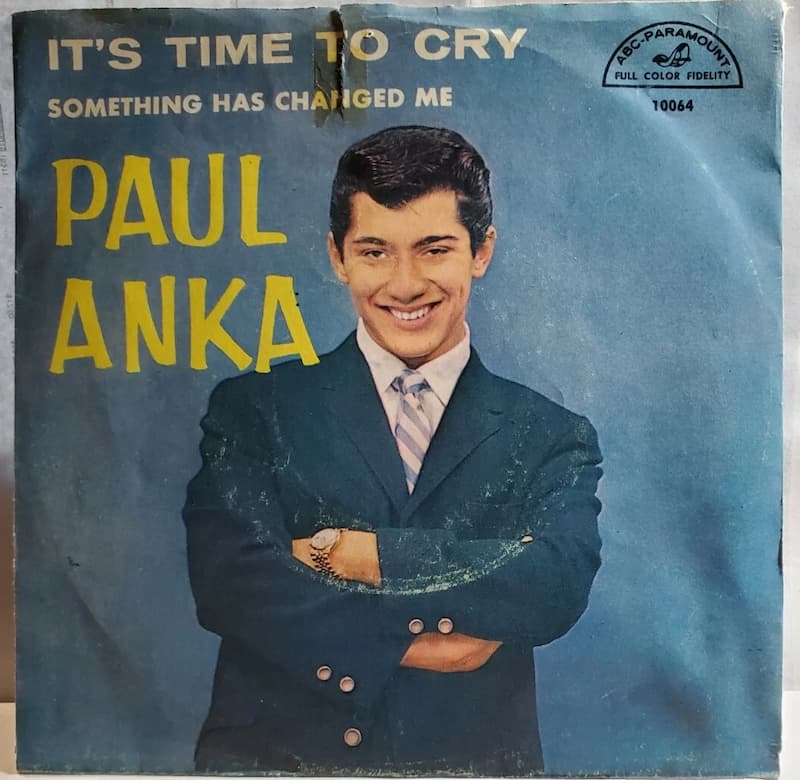
“It’s Time to Cry” arrived at a moment when Paul Anka was moving fast enough that his new releases almost felt like weekly events. He wrote the song himself and issued it in October 1959 on ABC-Paramount, coming right on the heels of “Put Your Head on My Shoulder.” The timing mattered: by late 1959, Anka wasn’t just a teen idol who could sing—he was selling the idea that he could also supply his own next hit on command, with the same direct, diary-like language that had made audiences believe he was talking to them personally.
The single was paired with “Something Has Changed Me” on the B-side, and the label presented both sides as “real records,” not filler. Trade reviews from the period treated Anka as a reliable “singer-cleffer” (a singer who writes) and pointed to the lush chorus-and-orchestra backing as part of the formula. That detail captures the late-’50s pop sound Anka was working in: even when the lyric is intimate and conversational, the production frames it like a small movie, with strings and voices supporting every turn of the line.
As a song, it’s built around one plain conclusion: when the breakup becomes undeniable, there’s no clever escape hatch—this is the moment you finally cry. The lyric doesn’t chase metaphors; it stacks simple images of loneliness and regret, including a sharp twist where the narrator argues the pain won’t belong to just one person. That “both of us” framing helped separate it from a standard heartbreak ballad. It isn’t only about being left; it’s about the cost of ending something that once felt mutual, and the way pride collapses once the decision is real.
On the charts, the record performed like a continuation of Anka’s late-1959 run rather than a one-off surprise. It moved from Billboard’s “Bubbling Under” list into the main Hot 100, then climbed to a peak of No. 4 and stayed on the Hot 100 for 15 weeks. It also showed up strongly outside the U.S., reaching the Top 5 in Canada and charting in markets like the U.K., Australia, and Italy. At year’s end, Billboard ranked it among the biggest songs of 1960, which is a useful reminder of how long these records lived on radio compared with the faster turnover of later decades.
The record’s release also sits inside a very specific sequencing of Anka’s early catalog. In the space of months he moved from “Put Your Head on My Shoulder” to “It’s Time to Cry,” and then into “Puppy Love” shortly after—three records that sound like different chapters of the same youth-romance universe. That continuity is part of why “It’s Time to Cry” mattered: it didn’t break the character Anka had built; it deepened it, giving his audience a “sad chapter” that still fit the voice and the persona they already trusted.
Like many early Anka titles, the song developed a second life through covers, especially from harmony-driven pop groups who heard how neatly the melody supported stacked vocals. The Lettermen recorded it for their 1964 album She Cried, a move that fits their brand perfectly: soft pop ballads delivered with blend and polish. When a tune can travel from a late-’50s teen-pop orchestral single to a mid-’60s vocal-group album without needing surgery, it usually means the writing is doing a lot of work beneath the production.
What’s left today is a record that functions as both a hit and a snapshot of how pop was made in 1959: a short runtime, a big arrangement, and a lyric that tries to sound as if it was written in the moment. “It’s Time to Cry” didn’t become Anka’s signature in the way “Diana” did, but it helped confirm the pattern that defined his early career—write it, sing it, release it quickly, and let radio carry the story forward to the next chapter.
Video
Lyric
When somebody leaves you
That’s the time to cry
When you know you’re lonely
You’re not the one and only who will cry
When your heart is broken
That’s the time to cry
When you know she has left you
You’ll know that she has left you, so you can cry
Happiness is what I long for
Loneliness is why I cry
For you have made my heart a slave
And now it’s up to you
When somebody leaves you
That’s the time to cry
When you know she has left you
You’ll know that she has left you, so you can cry