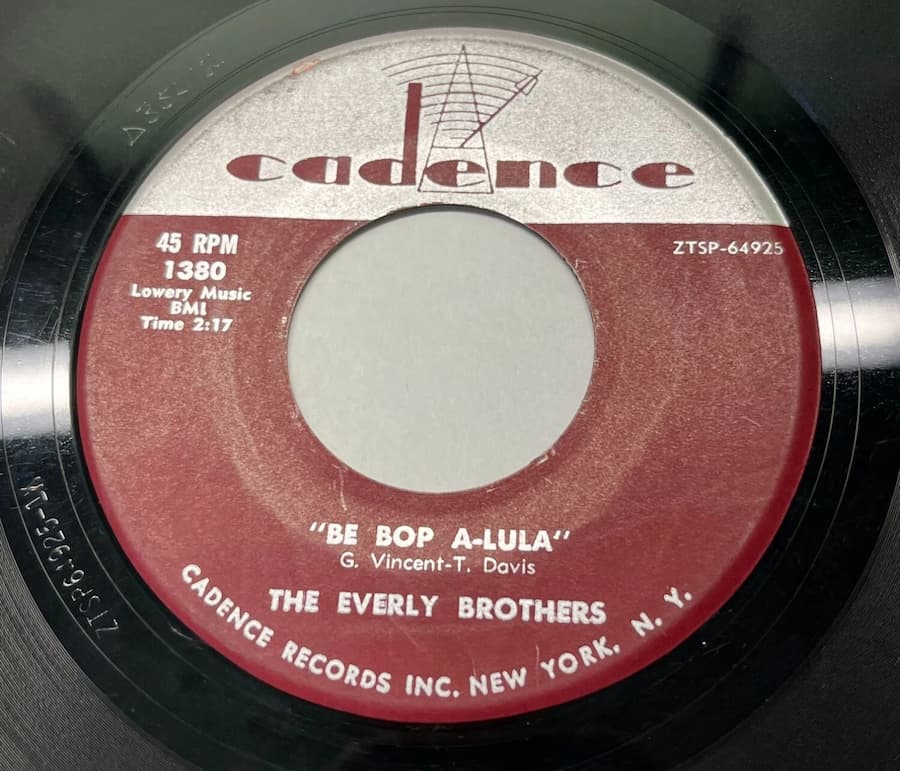
About The Song
Be-Bop-A-Lula by The Everly Brothers appeared on their self-titled debut album in 1958, a record that collected some of their early hits alongside a handful of covers. The album itself climbed to No. 16 on Billboard’s Best-Selling Pop LPs chart, riding the wave of the brothers’ rapid rise after “Bye Bye Love” and “Wake Up Little Susie.” Their take on “Be-Bop-A-Lula” wasn’t issued as a major single at the time, though a version later surfaced in 1960 and scraped the lower reaches of the charts.
The song had already become a rock ’n’ roll staple two years earlier when Gene Vincent and His Blue Caps cut it in Nashville. Written by Vincent along with Donald Graves and Bill “Tex” Davis, it was originally the B-side to “Woman Love” but quickly overtook it once DJs started spinning the more energetic flip. The Everlys recorded their version during the same productive stretch that produced their first string of smashes on Cadence Records. Placing a full-throated rockabilly number like this on their debut LP showed they were comfortable stepping outside the country-tinged material that had made their name, while still bringing their trademark close harmonies to the party.
For the brothers, covering a recent hit wasn’t unusual in those early days. Their live sets and early recordings mixed current rock ’n’ roll favorites with the songs that would become their signatures. “Be-Bop-A-Lula” fit right in as a high-energy crowd-pleaser, the kind of track that let Don and Phil show off how naturally their voices locked together even on material that had been built around a single lead singer. They kept it in the setlist for years and brought it back for their celebrated 1983 reunion concerts at the Royal Albert Hall, where it sat comfortably alongside the classics that had defined their career.
The track never became one of their biggest chart entries on its own, but it served as a bridge between the rockabilly explosion of the mid-1950s and the more polished harmony sound the Everlys helped popularize. In an era when artists routinely swapped songs across genres, their version stood as a reminder that the brothers weren’t just hitmakers—they were sharp interpreters who could take a raw, urgent rock ’n’ roll tune and make it feel like part of their own story.
Video
Lyric
Well, be bop a-lula, she’s my baby
Be bop a-lula, I don’t mean maybe
Be bop a-lula, she’s my baby
Be bop a-lula, I don’t mean maybe
Be bop a-lula, she’s my baby doll,
My baby doll, my baby doll
She’s the woman in the red blue jeans
She’s the woman that’s the queen of the teens
She’s the one woman that I know
She’s the woman that loves me soBe bop a-lula, she’s my baby
Be bop a-lula, I don’t mean maybe
Be bop a-lula, she’s my baby doll,
My baby doll, my baby dollShe’s the woman that’s a got that beat
She’s the woman with the flying feet
She’s the one woman that I know
She’s the woman that loves me soBe bop a-lula, she’s my baby
Be bop a-lula, I don’t mean maybe
Be bop a-lula, she’s my baby doll,
My baby doll, my baby dollBe bop a-lula, she’s my baby
Be bop a-lula, I don’t mean maybe
Be bop a-lula, she’s my baby
Be bop a-lula, I don’t mean maybe
Be bop a-lula, she’s my baby doll,
My baby doll, my baby doll